A Tech Buyer’s Guide To Mountain View Micro-Neighborhoods
May 14, 2026
May 14, 2026
Trying to pick the right part of Mountain View can feel harder than deciding whether to rent or buy in the first place. In a compact city, a few blocks can change your commute, your home options, and how often you reach for your car. If you want a smarter way to compare Mountain View’s micro-neighborhoods, this guide will help you match your budget, work style, and daily routine to the right pocket of town. Let’s dive in.
Mountain View is small, but it does not live small. Citywide, the Walk Score is 66, the Transit Score is 41, and the Bike Score is 92, which tells you the city can work well for car-light living depending on where you buy.
That said, the difference between neighborhoods is meaningful. Old Mountain View has a Walk Score of 83, while North Bayshore is at 25. For a tech buyer, that gap can shape everything from your morning commute to whether you want a condo near transit or a house on a quieter residential street.
Before you compare prices, start with how you actually want to live. The best neighborhood for you is usually the one that matches your commute pattern, maintenance tolerance, and preferred home type.
Here is a simple way to think about the main Mountain View options:
Pricing helps narrow the list fast, but it is important to read neighborhood medians carefully. In several of these micro-neighborhoods, only a handful of homes sold in March 2026, so median prices can move around from month to month.
Based on Redfin’s March 2026 snapshots, the practical budget ladder looks like this.
| Neighborhood | Median Sale Price | Market Pace |
|---|---|---|
| Monta Loma | $1,918,500 | Limited monthly sales |
| Old Mountain View | $2.3M | 12 days on market |
| The Crossings | $2.4M | 8 days on market |
| Cuesta Park | $2.7M | Noted as a higher-price residential pocket |
If you are shopping in a tight range, treat these numbers as directional rather than fixed. A small sample size means your target home’s condition, layout, and exact location can matter even more than the headline median.
Old Mountain View is the city’s most urban-feeling pocket. The neighborhood centers on Castro Street and includes the downtown business district, with parks like Pioneer Memorial and Eagle Park plus a mix of Victorian homes and cottages.
For buyers who want a true leave-the-car-home lifestyle, this is often the first stop. Walk Score rates Old Mountain View at 83 walk, 52 transit, and 95 bike, which makes it the strongest fit for people who value nearby dining, errands, and an active street scene.
This convenience usually comes at a premium. Redfin’s March 2026 snapshot put the median sale price at $2.3 million, with homes averaging 12 days on market.
Old Mountain View can make sense if you want a neighborhood that feels connected and active. If your ideal week includes walking to coffee, dinner, or downtown events, this area checks a lot of boxes.
It can also appeal if you want charm and variety in housing stock. Because the area includes older homes and cottages, your tradeoff may be lot size, layout differences, or a busier setting compared with more suburban-feeling parts of Mountain View.
If your top priority is station access, The Crossings stands out. The neighborhood was developed as an 18-acre infill project near the San Antonio Caltrain station, with homes, retail, daycare, and pocket parks designed around short walking distances.
The planning intent still shows up in daily life. Residents can walk from home to stores or the station in under five minutes and to a park in two minutes or less, according to the EPA’s neighborhood profile.
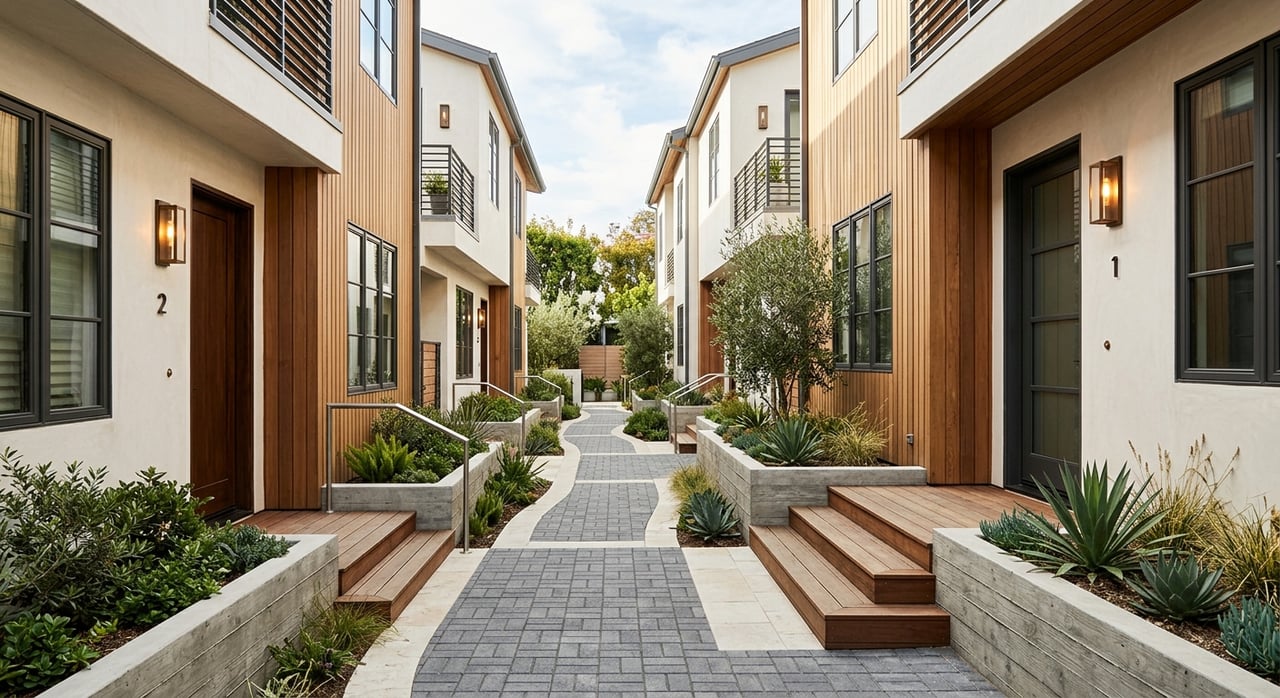
The housing mix is broad for a compact area. You will find single-family bungalows, smaller cottages, townhouses, and condo apartments, which makes The Crossings worth a close look if you want options across maintenance levels and price points within one neighborhood.
Apartments.com rates the neighborhood at 60 walk, 60 transit, and 70 bike. Redfin’s March 2026 snapshot showed a median sale price of $2.4 million and an average of just 8 days on market.
For many busy professionals, time is the real budget. The Crossings can work well if you want a daily routine built around rail access, shorter errand runs, and a home that may require less upkeep than a larger detached property.
It is especially practical if you want to stay flexible. Townhomes and condos here may offer a simpler ownership experience than older single-family homes in other parts of Mountain View.
North Bayshore is less like a classic neighborhood and more like a job-hub district with a smaller residential footprint. The city’s precise plan describes it as a place that protects habitat while planning for sustainable and innovative commercial and residential development.
For buyers, the key story is access. The city highlights transit boulevards to improve last-mile connections from the Mountain View Transit Center to North Bayshore, and MVgo shuttles connect the Transit Center to North Bayshore, East Whisman, San Antonio, and downtown Mountain View.
The free Mountain View Community Shuttle also runs from 50 stops throughout town. That matters if your goal is to reduce drive time without relying on a neighborhood that is highly walkable in the traditional sense.
Walk Score ranks North Bayshore at 25 walk, 29 transit, and 75 bike. In practical terms, many buyers here are trading yard space and classic residential density for office access and strong bike or shuttle convenience.
This area can be a smart match if your work location drives your housing decision. If being close to major employment centers matters more than being near a traditional main street, North Bayshore deserves a spot on your list.
It may be less ideal if your priority is strolling to restaurants or daily errands. Compared with Old Mountain View or The Crossings, this is a more commute-driven choice.
Cuesta Park offers a different rhythm. The neighborhood is centered on park access and a more residential feel, with about 1,854 living units within boundaries that include Miramonte Avenue, El Camino Real, Grant Road, and the back side of Cuesta Park and Villa Siena.
The neighborhood association’s community activities help illustrate the tone of the area. Monthly meetings, produce drives, little free libraries, and parent meetups point to a well-established neighborhood structure rather than a downtown atmosphere.
A nearby Cuesta Drive location carries a Walk Score of 61, Transit Score of 34, and Bike Score of 90. Redfin’s March 2026 snapshot showed a median sale price of $2.7 million.
If you want a more residential setting with strong bike access, Cuesta Park is worth watching. It tends to appeal to buyers looking for a quieter daily environment while staying within Mountain View.
The tradeoff is budget. Based on current median pricing, Cuesta Park sits above several other micro-neighborhoods discussed here.
Monta Loma and Rex Manor are some of Mountain View’s most recognizable house-centric pockets. Monta Loma has about 1,008 households and is known for many 1950s-era California Modern homes, including Eichlers, Mardells, and Mackays.
The neighborhood also benefits from practical central access. Its boundaries place it near San Antonio Road, Central Expressway, Rengstorff Avenue, and Middlefield Road, with easy access to Highway 101, Central Expressway, and El Camino Real.
Rex Manor shares some of that appeal but with its own identity. Neighborhood sources emphasize quiet, tree-lined streets, limited through traffic, and Stevenson Park as a local anchor.
Walk Score ranks Monta Loma-Farley-Rock Street at 68 walk and 95 bike. Redfin’s March 2026 median sale price for Monta Loma was $1,918,500, making it one of the more approachable entries in this group.
These neighborhoods can be especially attractive if you care about architecture and want more of a classic house neighborhood feel. Mid-century homes often appeal to buyers who value design, indoor-outdoor flow, and a distinct identity.
You may also find the value equation compelling. Compared with some higher-priced Mountain View pockets, Monta Loma gives buyers a way into a well-known neighborhood at a lower median price point.
Not every buyer lands in the first five neighborhoods they tour. Waverly Park and Blossom Valley are useful alternatives if your search is pulling you toward a more suburban feel.
Historic city context offers helpful clues here. Waverly Park’s development history points to larger-lot, single-family character, while Blossom Valley Plaza opened in 1957 to serve the new suburban neighborhoods south of El Camino Real and was designed in a ranch style that matched nearby homes.
These two areas are worth adding to your list if you want to compare a more traditional residential setting against the denser or more transit-oriented parts of Mountain View.
For tech buyers, commute planning often decides the neighborhood before anything else. Mountain View Station is served by Caltrain and VTA light rail’s Orange Line, and the station includes paid parking, bike racks, and direct Caltrain connections.
Caltrain’s station connections also list access to VTA routes 21, 40, 51, and 52, the Orange Line, and MVgo shuttle routes A through D. That gives you a practical framework for choosing between a car-light lifestyle and a more car-first setup.
If your commute depends on rail access, start with:
If your commute works better by bike or shuttle to job centers, look closely at:
If your priority is a residential setting and you do not mind using a car more often, consider:
When clients narrow down Mountain View, the decision usually becomes simpler when they rank these four questions in order.
If you answer those honestly, the field starts to shrink fast. A transit-first buyer may lean toward The Crossings, while someone who wants design character and a detached home may focus on Monta Loma or Rex Manor.
The right neighborhood is rarely the one with the most buzz. It is the one that makes your workweek easier and your weekends feel more like your own.
If you want help comparing Mountain View micro-neighborhoods based on your commute, budget, and housing goals, David Kim Group can help you build a focused, efficient search strategy.

Market Update
Partner with our dynamic team to unlock the full potential of your real estate endeavors in Silicon Valley. With our tailored approach and in-depth market knowledge, we'll ensure a seamless and extraordinary client experience.
Connect With Our Team to Learn More

19900 Stevens Creek Blvd, #100 Cupertino, CA 95014 David Kim | CA DRE# 01527235 Keller Williams Thrive | CA DRE# 02177478