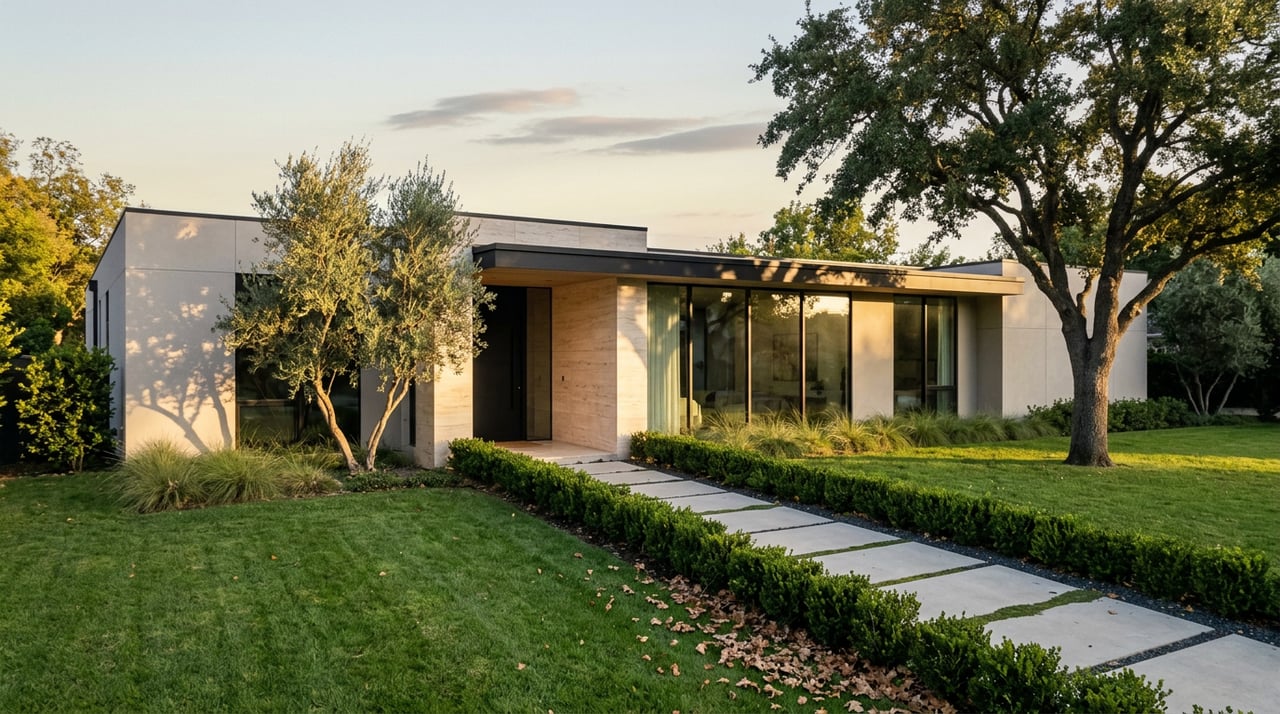
In Los Altos, You're Not Bidding on a House. You're Bidding on the Lot.
September 24, 2026
September 24, 2026
You walk through a 1958 rancher on a quiet cul-de-sac in North Los Altos. The light in the kitchen is good, the yard has room for the pool your kids have been asking about, and you can picture five years of your life inside it. You write a strong offer. You lose by a margin that makes no sense until someone tells you the winning buyer never planned to live there and may never have set foot past the front door.
That is the moment worth explaining, because it is not a fluke. In Los Altos, more than almost anywhere else on the Peninsula, the price a home commands has less to do with the structure standing on it and more to do with what a builder's spreadsheet says the underlying parcel is worth. A dated three-bedroom ranch and the architect-designed new build next door can land within a few dollars of each other on a price-per-square-foot basis, once you separate what each structure actually contributes from what the dirt underneath it is worth on its own.
Builders and small developers who bid on Los Altos teardown candidates rarely price the existing house at all. They start with what a finished new home will sell for on that specific block, then work backward: subtract construction costs, permitting and design review time, financing carry, and the margin they need to make the project worth doing. What's left is the most they can justify paying for the land. This is standard land economics, but in a city where finished new construction routinely clears eight figures, that residual number can dwarf what an owner-occupant would ever offer based on the house's condition alone.
The house is a placeholder. The land is the asset.
In most markets, this kind of land premium eventually gets diluted as builders add supply and compete the price down. In Los Altos, local development rules shape how much new supply can be added.
The city's own SB9 information guide lays out standards for lot splits and dual-unit development.
California's SB9 was written to loosen exactly this kind of constraint statewide, letting owners split a qualifying lot or add a second unit through a ministerial process that skips discretionary hearings. Los Altos has adopted the law, but an independent tracker of city-by-city SB9 implementation, Homestead, has graded the city's approach a C for layering additional objective standards on top of the state's minimum requirements. The mechanism state law built to add supply exists here, but its effect depends on how those standards apply.
The Los Altos Town Crier reported that a project on First Street was submitted under California's Builder's Remedy provision this past August, bypassing normal zoning review, and covered the resulting Planning Commission meeting. Around the same time, a separate local ballot measure, Measure D, asked voters whether the city's downtown parking plazas should be reworked. Together, the project and the measure reflect different debates about how Los Altos may change over time.
Because the land premium isn't uniform, what you're actually paying for shifts depending on which part of the city you're standing in.
| Sub-area | What buyers are really paying for | Worth knowing |
|---|---|---|
| Old Los Altos & Country Club | Address and lot, more than the structure | Future rebuild options are worth checking |
| North Los Altos | Commute time, packaged with larger new-build homes | Sits closest to the Mountain View border, within a short drive of Google's main campus |
| Loyola Corners | Comparatively more house per land dollar | A smaller commercial node sits at Foothill Expressway and Magdalena Avenue, feeding into Loyola Elementary |
| South Los Altos | A patchwork that requires verification block by block | Attendance boundaries shift into Cupertino-adjacent areas, so feeder schools can differ street to street |
None of these differences show up in a citywide median. They show up when you compare two lots on paper and ask what a builder, not just a buyer, would be willing to pay for each one.
If you're selling a home that could plausibly pencil as a teardown candidate, the ceiling on your sale price isn't your neighbor's list price, it's what a builder's spreadsheet says the finished product on your lot is worth. A kitchen remodel that would move the needle for an end-user buyer may do far less for a buyer pool that includes people planning to demolish. Before you spend on cosmetic updates, it's worth understanding which pool your specific lot is likely to draw, which is exactly the kind of read a current value estimate grounded in local comps, not just square footage, can give you.
If you're buying, the practical takeaway is about leverage, not price. When you're competing against a builder for a home that also pencils as land value, your move-in story and your appreciation for the light in the kitchen don't factor into their math at all. What does is speed and certainty of close, because that's one of the few variables a builder's spreadsheet weighs the same way you do.
For a deeper look at how Los Altos stacks up against Palo Alto, Cupertino, and its other Peninsula neighbors on the metrics that actually matter to a move-up buyer, our earlier piece on how Los Altos compares to nearby cities is a useful next read, and our Los Altos neighborhood page breaks down the sub-areas in more detail.
Does renovating before I sell still make sense here? It depends on which buyer pool your home is likely to draw. If your lot and location make it a realistic teardown candidate, a full kitchen or bath remodel may not move your final sale price as much as it would in a market without that dynamic. If your home is more likely to sell to an end-user, the usual logic still applies.
What is SB9, and could it change what I can do with my lot? SB9 is a state law that allows qualifying single-family lots to add a second unit or split into two parcels through a streamlined process. Whether it applies to your specific lot in Los Altos depends on parcel size, frontage, and a set of local objective standards the city has layered on top of the state minimums, so it's worth confirming with the city's planning department before assuming it changes your property's value.
Why does a home in North Los Altos price so differently per square foot than one in Old Los Altos? The two areas are selling different things. North Los Altos trades heavily on commute proximity and larger, newer construction. Old Los Altos trades on established lots, mature trees, and a downtown-adjacent address that the Design Review Commission works to preserve. Both premiums are real, they're just built on different inputs.
Understanding whether you're bidding against a family or a spreadsheet changes how you should approach either side of a Los Altos transaction. If you're weighing whether to prep your home for market or want a clear-eyed read on what your specific lot is worth to today's buyer pool, the team at David Kim Group can walk through the numbers with you block by block. Schedule a Consultation to get started.
This article is general information, not legal, tax or financial advice. Consult a qualified professional about your situation.

Market Update
Partner with our dynamic team to unlock the full potential of your real estate endeavors in Silicon Valley. With our tailored approach and in-depth market knowledge, we'll ensure a seamless and extraordinary client experience.
Connect With Our Team to Learn More

19900 Stevens Creek Blvd, #100 Cupertino, CA 95014 David Kim | CA DRE# 01527235 Keller Williams Thrive | CA DRE# 02177478